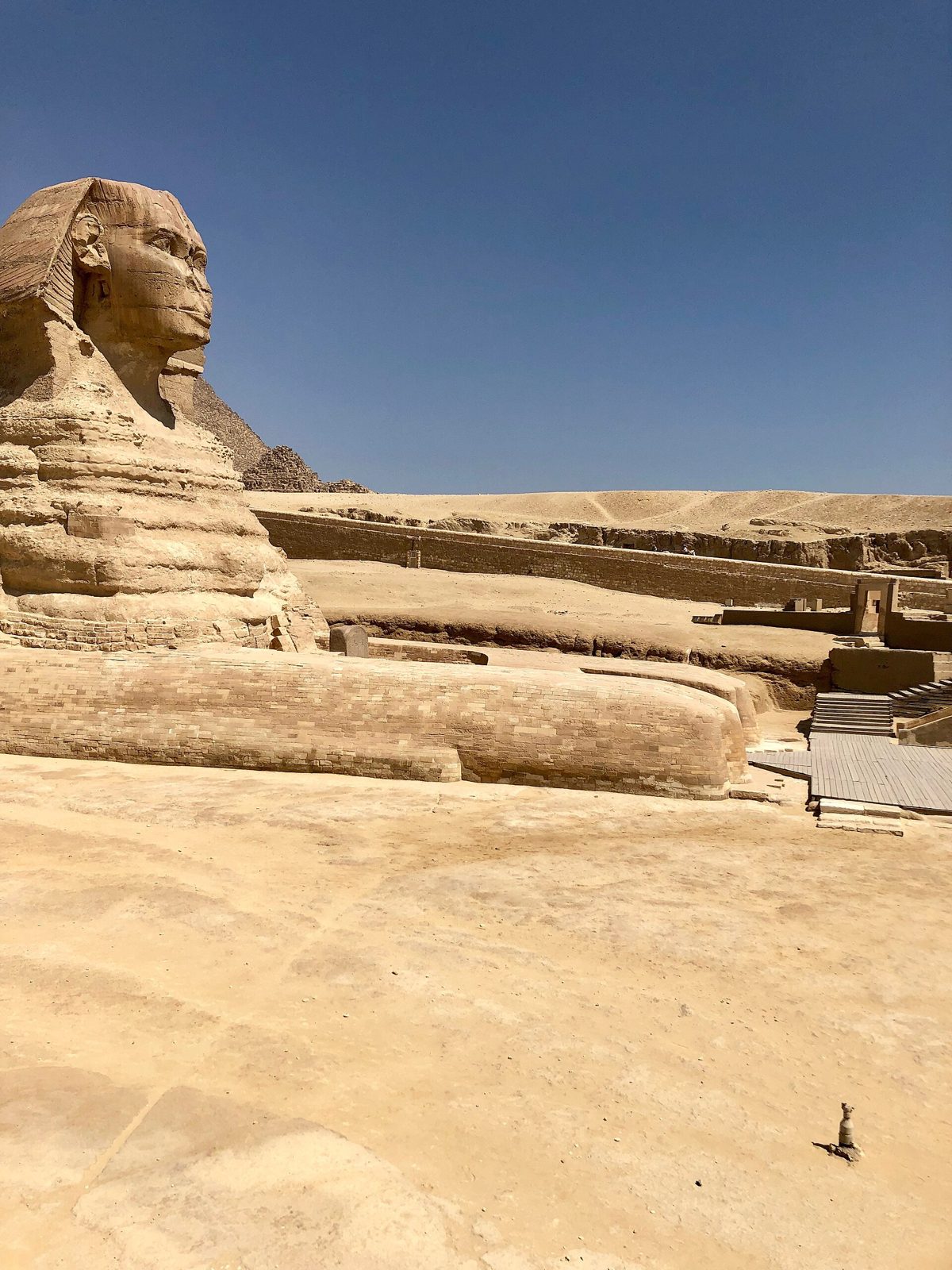
- The Valley Temple of Khafre stands beside the Sphinx and is the best preserved Old Kingdom building on the Giza plateau.
- Its hall of red granite pillars over a pale alabaster floor carries no reliefs or inscriptions at all.
- The famous seated diorite statue of Khafre with the Horus falcon was found in a pit in this temple and is now in Cairo.
- It lies on the standard route from the Sphinx entrance and is covered by the plateau ticket.
Most visitors walk through the Valley Temple without registering what it is. It stands beside the Sphinx, the path runs through it toward the viewing terrace, and after the pyramids a low building is easy to miss. It should not be. This is the best preserved Old Kingdom building on the plateau, and the one place at Giza where you can stand inside a room that has kept its original walls, pillars and floor.
This guide explains what the Valley Temple was for, what survives, what was found buried in it, and how to see it properly on a normal visit to the Pyramids of Giza.
What a Valley Temple Was For
Which Valley Temple?
Every pyramid complex had one, so "the Valley Temple" on its own is ambiguous. Menkaure's valley temple stands further south on the plateau, largely of mudbrick and far less complete, and valley temples survive in ruin at other pyramid sites. This guide is about the valley temple of Khafre beside the Sphinx, the one visitors walk through and the best preserved of them all.
Every pyramid complex had three parts joined in a line: a valley temple at the edge of the floodplain, a causeway climbing the escarpment, and a mortuary temple against the pyramid itself. The valley temple was the point of arrival. Boats could reach it when the river was high, and the king's body and the offerings entered the complex here. Our guide on why the Egyptians built pyramids explains the beliefs behind that design.
Ancient and modern writers have linked the building to purification and embalming rituals. The evidence is indirect, and the safest description is the one the architecture supports: this was the formal entrance to the complex of Khafre.
What Survives
The Core and the Casing
The walls are built of limestone blocks of enormous size, some weighing many tons, and they were faced inside and out with red granite brought down the Nile from Aswan. Much of that granite is still in place.
The T-Shaped Hall
The main hall is a T on plan, its roof once carried on sixteen square monolithic granite pillars. Enough of them stand to give the proportions, and the lintels they support are single blocks spanning the gaps.
The Alabaster Floor
The floor is Egyptian alabaster, pale and translucent, and the contrast with the dark red granite above it was the whole design: light below, mass above, no decoration anywhere.
No Decoration at All
There are no reliefs, no inscriptions and no painted scenes in the hall. For a culture that covered every later temple in text and image, that restraint is striking, and it is typical of the Fourth Dynasty at Giza.