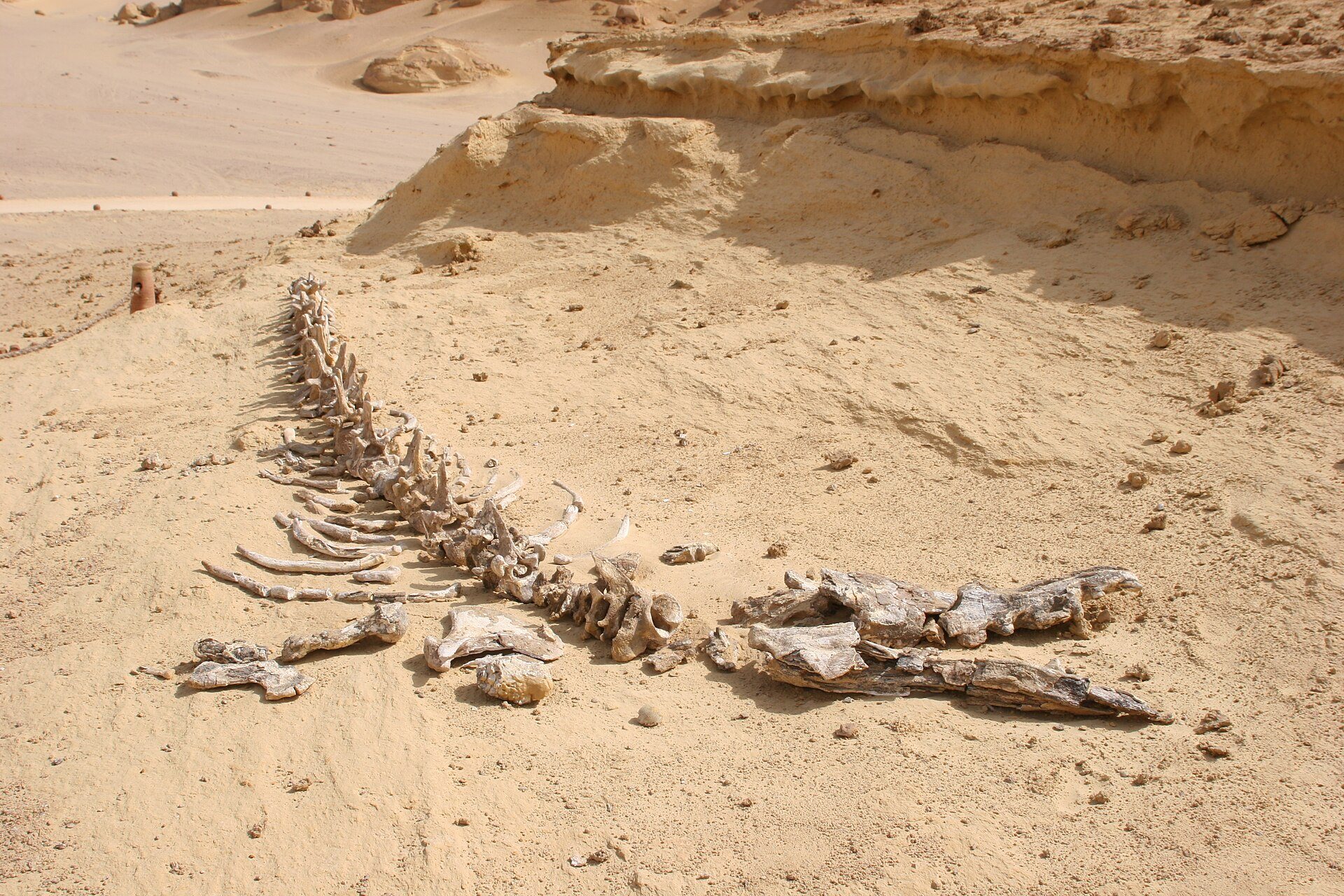
Fossil whale skeletons
UNESCO describes the evidence of the earliest whales as often in the form of complete skeletons. The fossils here show the youngest archaeocetes, in the last stages of losing their hind limbs.
Home / Attractions / Wadi El Hitan
Cairo & Giza · Fayoum Governorate, Western Desert
A strictly protected fossil site in Egypt's Western Desert, where the remains of the earliest whales show their change from land animals to ocean-going mammals.
Wadi El Hitan, also written Wadi Al-Hitan and known as Whale Valley, is a protected fossil site in the Western Desert of Egypt, in Faiyum Governorate. It holds the remains of the earliest whales, an extinct suborder called Archaeoceti, whose fossils record the change from a life on land to life in the ocean.
UNESCO inscribed the site in 2005 under criterion (viii) and calls it the most important site in the world for showing this stage of whale evolution. The number, concentration and quality of the fossils are unique, UNESCO says, as is their accessibility in a protected landscape. The property covers 20,015 hectares, with a buffer zone of 5,885 hectares, inside the Wadi El-Rayan Protected Area.
UNESCO describes the evidence of the earliest whales as often in the form of complete skeletons. The fossils here show the youngest archaeocetes, in the last stages of losing their hind limbs.

The fossils lie in a strictly protected zone within the wider Wadi El-Rayan Protected Area, a setting UNESCO calls attractive. Visitor facilities guide people to the key localities along footpaths and keep vehicles out of the property.
| From Cairo hotels to Wadi El Hitan | about 3 h 39 min by road and desert track |
|---|---|
| From Cairo hotels to Wadi El Rayan | 143.2 km · about 1 h 48 min |
Without traffic, from our tours' map routing
Our Whale Valley private day trip from Cairo stops here: a long day on a desert track, with a suitable vehicle and lunch. Map routing from the Fayoum day trip puts Wadi El Hitan about 3 h 39 min from Cairo without traffic.
The coolest months are December to February.
World Meteorological Organization climate normals (monthly averages, not forecasts)
Wadi El Hitan, or Whale Valley, is a UNESCO World Heritage site in Egypt's Western Desert with fossils of the earliest whales, an extinct suborder called Archaeoceti. The fossils show whales changing from land animals to ocean-going mammals.
For travelers interested in fossils and desert landscape, yes: UNESCO calls it the most important site in the world for showing this stage of whale evolution. It is a long day from Cairo, so it suits a trip planned around it.
Map routing puts it about 3 h 39 min from Cairo without traffic, partly on a desert track. The nearer Wadi El Rayan lakes are 143.2 km, about 1 h 48 min, from a Cairo hotel.
Yes. UNESCO describes the evidence of the earliest whales as often in the form of complete skeletons, and visitor facilities guide people to the key localities along footpaths.
Dress modestly, as advised across Egypt, and bring sun protection and a hat, with sturdy shoes for sand and rock. Drones need Ministry of Defence permission.
The Nature Conservation Sector of the Egyptian Environmental Affairs Agency manages the site as part of the Wadi El-Rayan Protected Area. UNESCO describes it as a strictly protected zone.
Sources: UNESCO World Heritage Centre; Egypt's Ministry of Tourism and Antiquities; UK Foreign, Commonwealth and Development Office; World Meteorological Organization.
Day tours
Guides
 Best Cairo day tours for first-time visitorsOur Cairo tours compared by what they cover and how long they run, and how to pair them without repeats.
 Egypt day tours by city: what you can do from each baseWhat you can do from each of our 8 bases, from the Giza pyramids to the Red Sea reefs.
 Planning several day tours in one Egypt tripPlan by base, avoid repeated stops, and mix long drives with short days.