The Major Animal Motifs
Cattle
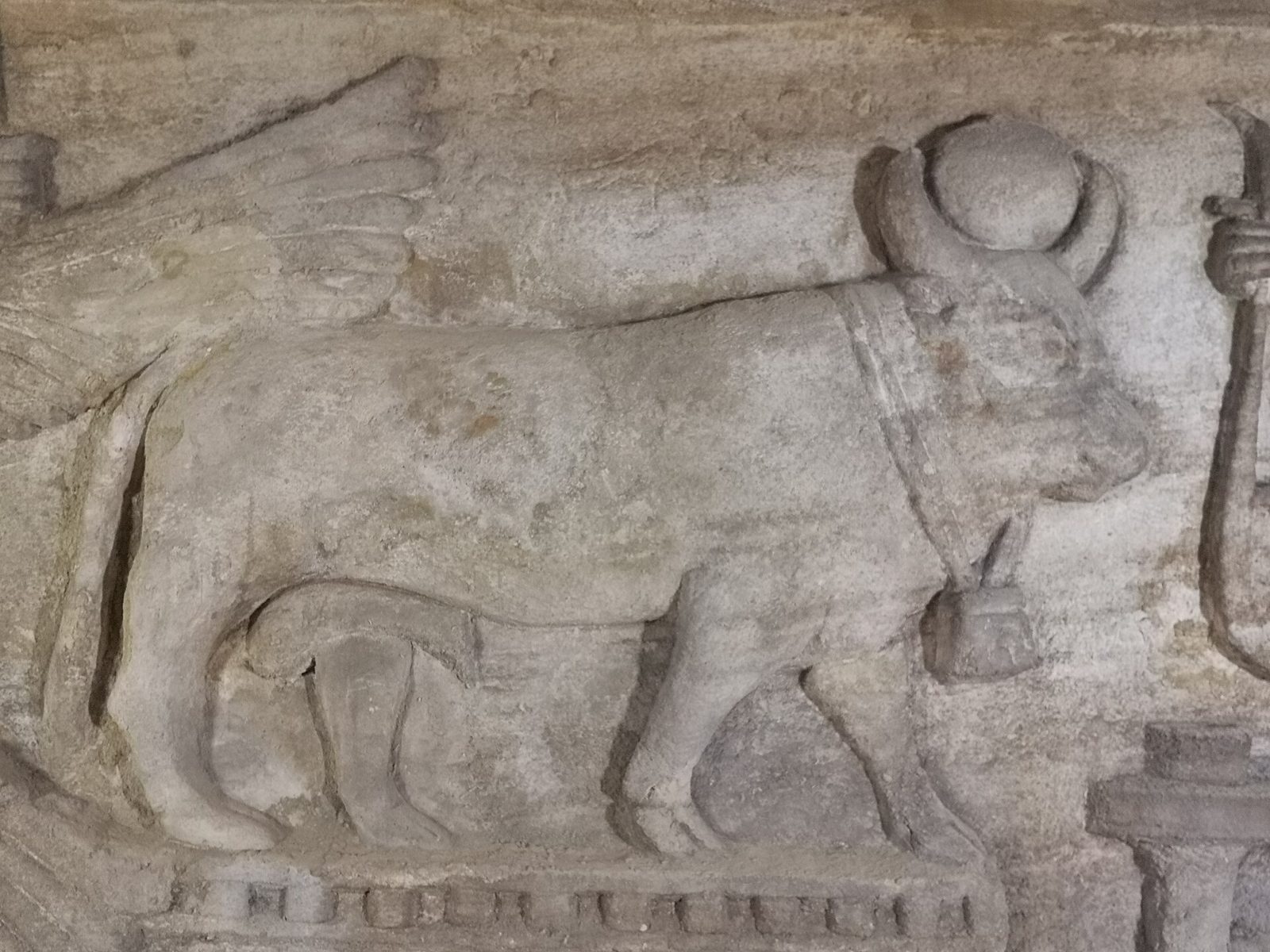
Cattle were the dominant domestic animal and the unit of wealth. Herds being counted before a seated owner is one of the most repeated scenes in Egyptian art. Cattle also carry divine weight: the sky as a vast cow whose legs are the pillars of the world, and the royal title that calls the king a strong bull.
Lions and Cats
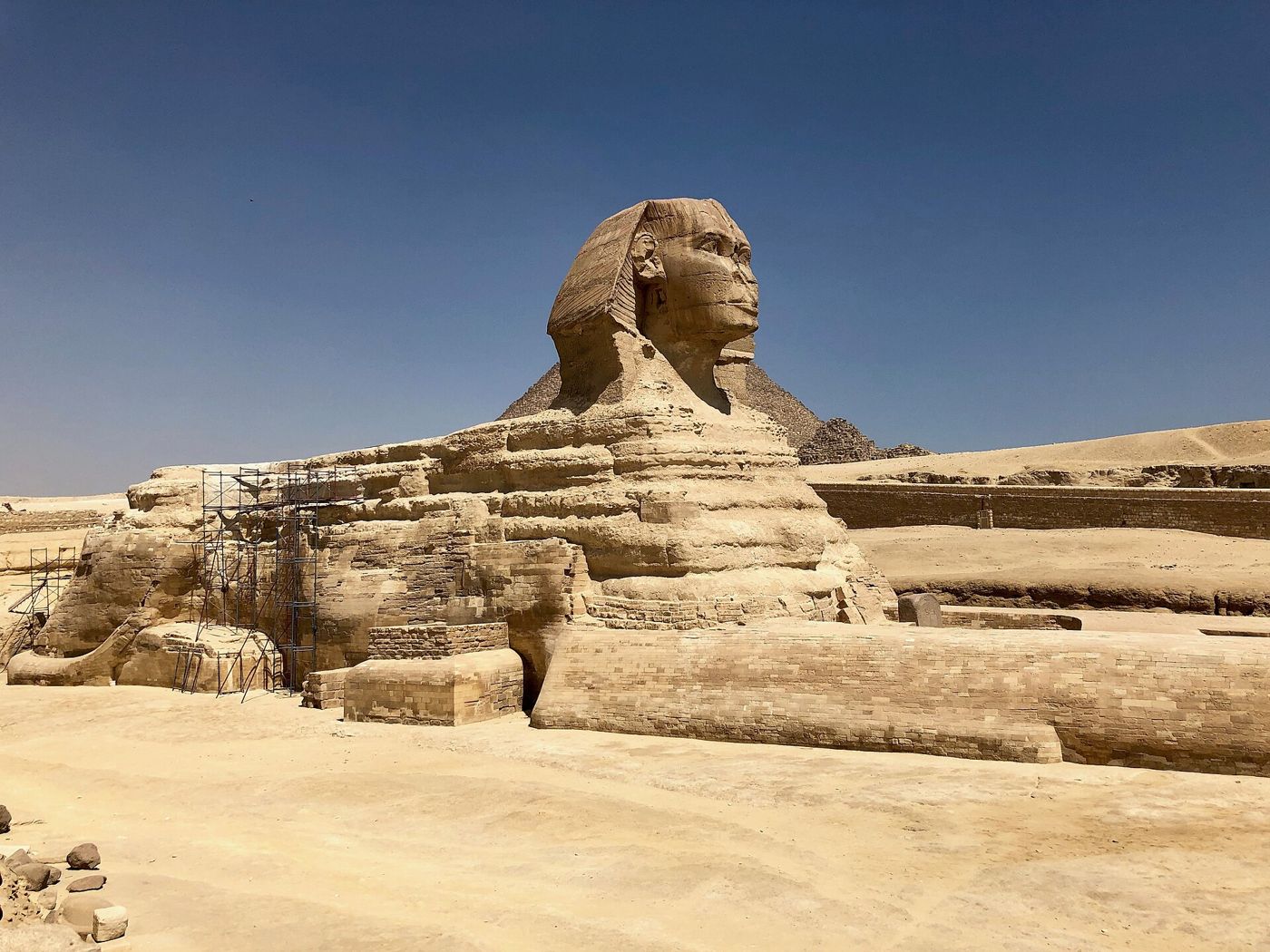
Lions guard: at gateways, as furniture legs, as the sphinx. The domestic cat appears under chairs in New Kingdom tomb paintings, often with a fish, and sometimes with a very good observation of a cat's posture. Cats became enormously popular as votive bronzes in the later periods.
Falcons and Vultures
The falcon is kingship itself, perched behind the king's head and enfolding it with its wings in the great statue of Khafre. The vulture is protection from above, spread across tomb ceilings and over the brow of a royal diadem beside the cobra.
Crocodiles and Hippos
Both are danger, and both are therefore also power to be harnessed. A hippo in a marsh hunt is chaos being speared; a blue faience hippo in a tomb, covered in painted marsh plants, is a wish for the river's fertility. Crocodiles appear as the threat the dead must be protected from and as a god with a temple of his own.
Snakes and Scarabs
The cobra rears on the royal brow and encircles the sun disc. A giant serpent is also the chief enemy of the sun in the underworld books. The scarab, pushing its ball, became the standard image of renewal and the most reproduced amulet shape in Egyptian history.
Baboons, Jackals and Rams
Baboons sit with raised arms greeting the sunrise, a behavior Egyptians observed and read as worship. Canids, generally translated as jackals, crouch on tomb chests and guard cemeteries. Rams, in two distinct breeds with different horn shapes, stand for power and creative force.
Fish, Birds and the Marsh
Fowling and fishing scenes are among the loveliest things in Egyptian painting: a throw-stick raised over a thicket of papyrus, birds bursting off the water, clap-nets being hauled, tilapia in the shallows. The tilapia, which appears to take its young into its mouth and release them alive, became an emblem of rebirth.
Why It Is Not One-to-One
This is the core correction. A single god could appear as several animals, and a single animal could serve several gods. Thoth is both an ibis and a baboon. Lioness form belongs to a whole group of goddesses, not one. Falcon form is shared by a sun god, a war god, a funerary god and one of the protectors of the internal organs. Treating each animal as the badge of one deity will make you misread half the scenes you look at.
Form, Not Identity
Egyptians did not believe the god was the animal. The animal was a form the god could take, one of several, alongside human form and the animal-headed human figure that modern audiences find most familiar. The same god could appear in all three modes in one temple, chosen according to what the scene needed to say.
Living Images
Separately, certain individual animals were treated as the living image of a god during their lifetime: a particular bull at Memphis, identified by its markings, kept in state, consulted as an oracle, and buried in a granite sarcophagus in catacombs built for the purpose. Other sacred bulls served at Heliopolis and at Armant. These were single animals, succeeded one at a time, not a whole species.
The Votive Mummy Industry
Later still, in the Late Period and after, animal mummies were produced in enormous numbers as offerings: ibises and baboons for Thoth, cats for a cat goddess, crocodiles for a crocodile god, and falcons, dogs, snakes and fish. Millions of bundles were placed in dedicated catacombs. Studies of these mummies have shown animals bred for the purpose, animals killed young, and some bundles holding only feathers, rags or a single bone, which says something about both the piety and the economics.
In Tombs, Temples and Sculpture
Tomb Painting
Private tomb chapels are where the animals are richest, because their subject is an abundant estate: herds, poultry yards, bird trapping, fish drying, the owner hunting in the marshes with his cat or his hounds. Beni Hasan, Saqqara and the Theban tombs of the nobles have the best walls.
Temple Relief
Temples use animals more formally: the falcon over the king, the vulture overhead, the cobra friezes, bulls in offering processions, and the god in animal or animal-headed form receiving the king.
Sculpture
Animal sculpture is where Egyptian artists were at their most relaxed and most confident: the granite falcons flanking a temple gateway, the seated lioness goddesses produced by the hundred for Theban temples, the alabaster sphinx at Memphis, the bronze cats of the Late Period with their earrings, the large Apis bull statues, and the small hard-stone animals of the Early Dynastic period.
Satire on Papyrus
A small, delightful category: papyri and limestone sketches showing animals in human roles. A cat herding geese, a lion and an antelope playing a board game, mice attacking a fortress defended by cats. Whether these illustrate fables, jokes or political satire is unresolved, and they are the one place where Egyptian art is plainly being funny.
Where to See the Best Examples
In Cairo
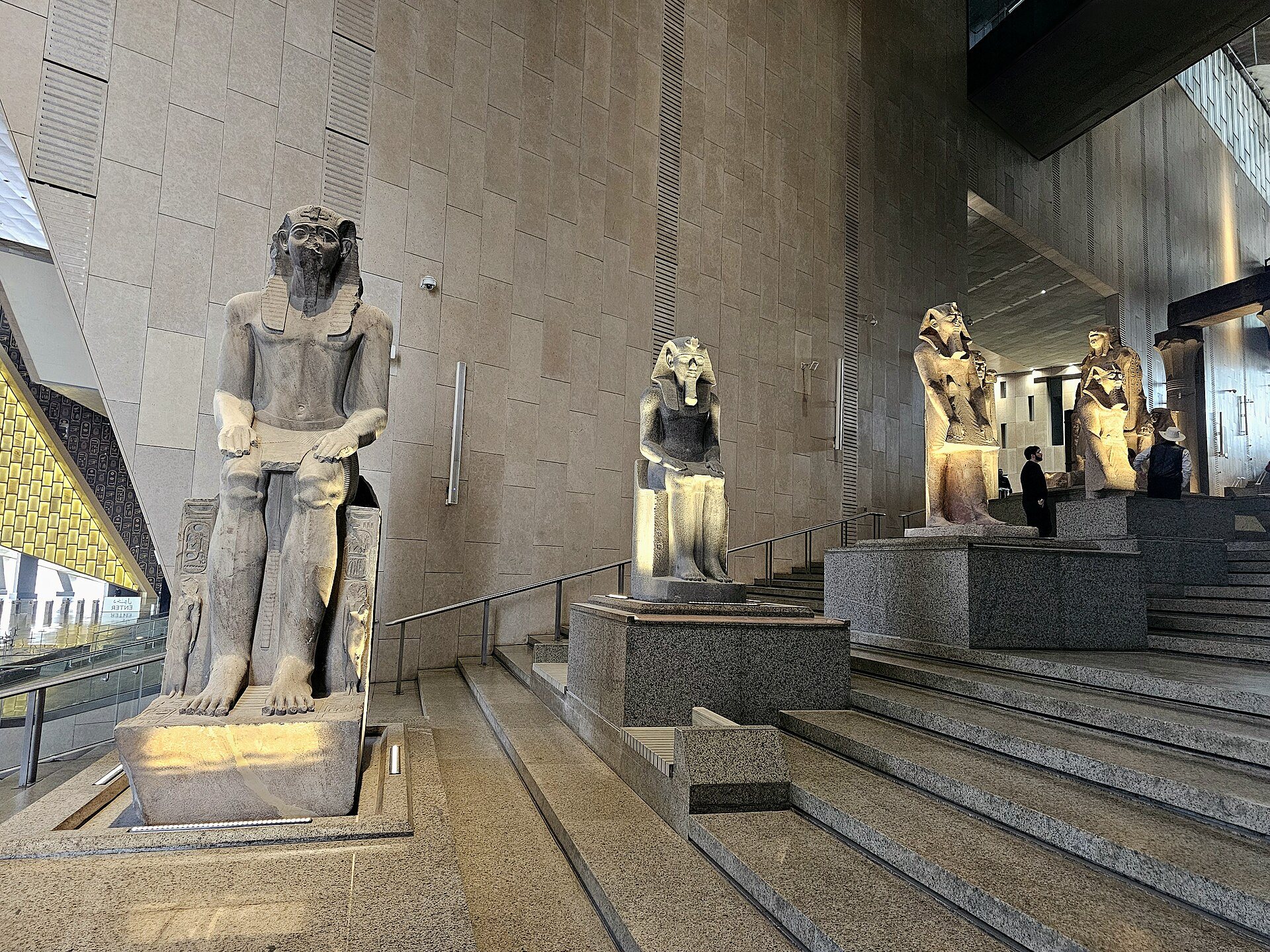
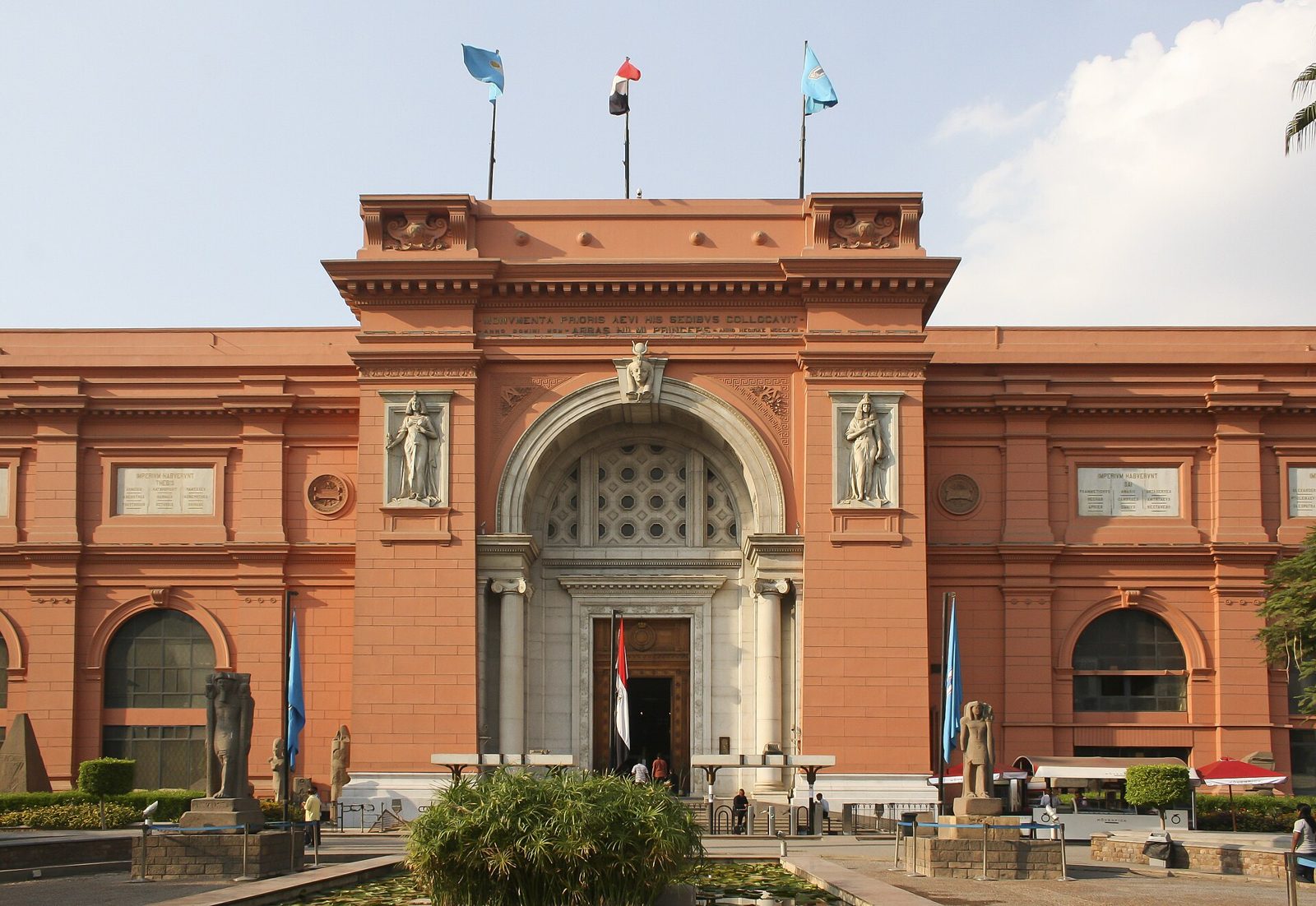
The Grand Egyptian Museum, the Egyptian Museum on Tahrir Square and the National Museum of Egyptian Civilization between them hold the great animal pieces: the falcon-backed Khafre, the painted geese from Meidum, bronze cats and ibises, animal mummy displays and small hard-stone animals. If you can see only one of the first two, our guide Egyptian Museum or Grand Egyptian Museum? helps you choose.
At the Sites
The Serapeum at Saqqara holds the bull sarcophagi, with the Bubasteion cat catacombs nearby. The crocodile museum at Kom Ombo shows mummified crocodiles beside the temple of the crocodile god, and Edfu and Kom Ombo together also give you the two granite falcons at the Edfu pylon. Tuna el-Gebel has the ibis and baboon galleries, and Beni Hasan the painted birds and hunting scenes.
A Caution on Labels
Some identifications are genuinely unresolved: the animal of Seth, the exact species behind the canid of the cemeteries, and several of the birds in damaged paintings. Good labels say so. Treat confident one-sentence explanations of Egyptian animal symbolism, in guidebooks or on signs, as simplifications.
FAQs About Animals in Ancient Egyptian Art
What animals were sacred in ancient Egypt?
Many, in different ways: bulls kept as the living image of a god, ibises and baboons linked to the god of writing, cats, crocodiles, falcons, rams, cobras, scarabs and more. Sacredness attached to a role in a cult, not to a species being holy in itself.
Why do cats appear so often in Egyptian art?
They were household animals valued for killing vermin and snakes, they appear in domestic tomb scenes from the New Kingdom onward, and lioness and cat forms belonged to several protective goddesses, which made bronze cats one of the most popular votive offerings in the later periods.
Did each Egyptian god have one animal?
No. Most gods had more than one form, including human form, and most animals were shared between several gods. The one-animal-one-god shorthand is the most common error in popular accounts.
Why are animals drawn more realistically than people?
Human figures followed a fixed formula designed to show a complete, ideal body. Animals were outside that convention, so artists drew them from observation, which is why species can be identified.
Are animal mummies real animals?
Usually, though studies of large deposits have found bundles containing only feathers, cloth or fragments, alongside animals that appear to have been bred and killed for the purpose.
What does the scarab mean?
Self-generation and renewal, from the beetle's habit of rolling a ball and seeming to emerge from the earth, which was read as the sun being pushed across the sky and reborn each morning.
Final Word: Learn the Animals, Read the Walls
Once you stop treating the animals as symbols to be looked up and start treating them as a language with context and ambiguity, Egyptian art opens up. The hippo is danger here and fertility there. The falcon behind the king's head is doing grammatical work. The cat under the chair is a cat, and also a promise about what the afterlife will feel like.
To see the animals in person, our private tour of the two museums, the Grand Egyptian Museum and the Egyptian Museum in Tahrir, covers both great Cairo collections in one day with a guide.